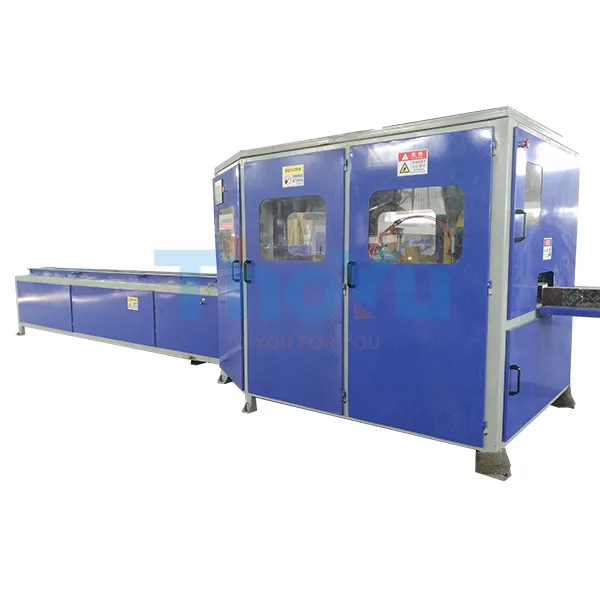
Compact Rotary Drum Wood Shavings Dryer: Energy-Saving Design for Uniform, Low-Moisture Output
17 02,2026
Technical knowledge
This article provides a technical overview of Zhengzhou Tuoyu Electromechanical Equipment Co., Ltd.’s compact rotary drum dryer designed for wood shavings and similar biomass materials. It addresses common drying challenges in wood processing—high energy consumption, uneven moisture removal, and large installation footprints—by explaining how a slightly inclined, rotating drum enables stable, continuous conveying with reduced risk of blockage. A direct hot-air flow system improves heat transfer and moisture evaporation consistency, while internal lifting flights increase material dispersion and contact area, supporting higher thermal efficiency and an estimated 30%–50% energy reduction compared with conventional setups. Operating within a controlled 150°C–180°C temperature range, the system is positioned to achieve final moisture contents below 10% under suitable feed conditions. The compact configuration is also highlighted for minimizing space requirements, simplifying installation, and lowering civil construction complexity. Optional cyclone dust collection and an energy-efficient hot air furnace are presented as practical add-ons to improve particulate control and overall operating economy. The content is structured to help procurement leaders and technical engineers evaluate performance drivers, integration requirements, and application value for evidence-based equipment selection.
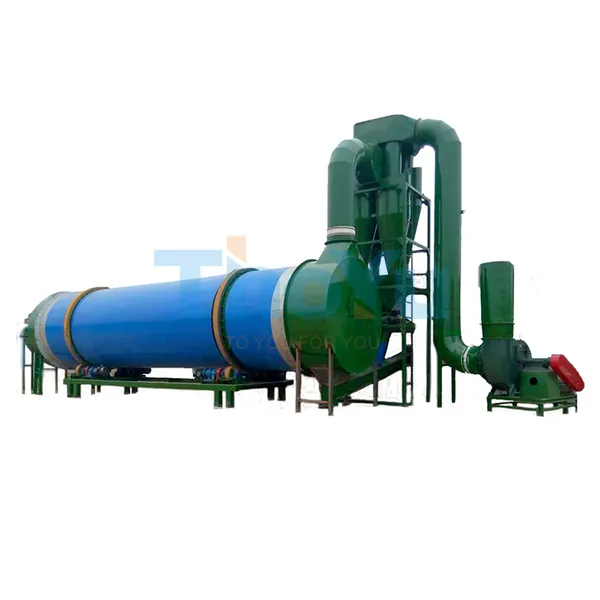
Compact Rotary Drum Dryer for Wood Shavings: A Technical Deep Dive into Higher Throughput and Lower Energy Use
In wood processing lines, drying is rarely the “headline” step—yet it often determines pellet quality, board stability, storage safety, and the real cost per ton. This article explains how Zhengzhou Tuoyu Electromechanical Equipment Co., Ltd. approaches the classic bottlenecks (uneven moisture, oversized footprints, and rising fuel bills) with a compact wood-shavings rotary drum dryer that combines a slightly inclined rotating drum and a direct hot-air contact system, plus internal lifting flights for stronger heat and mass transfer.
Keywords: wood shavings rotary drum dryer
energy-saving drying equipment
heat exchange efficiency
cyclone dust collection
Why Wood Shavings Drying Becomes a Production Bottleneck
Procurement leaders and plant engineers typically see the same pattern: raw material moisture fluctuates by supplier and season, while downstream processes (pelletizing, briquetting, MDF/particleboard blending, biomass boiler feeding) demand stable moisture. When drying performance drifts, problems appear quickly—steam bursts in pellet mills, poor binding, inconsistent bulk density, higher fines, and storage risks.
Common operational pain points (field-observed)
- Energy overspend: drying can account for 30–60% of thermal energy use in biomass material preparation lines (varies by starting moisture and fuel type).
- Non-uniform final moisture: “wet cores” and overdried fractions increase rework, blending time, and dust.
- Oversized installations: large footprints and heavy civil works inflate CAPEX and slow project schedules.
- Dust control pressure: stricter on-site air quality requirements push for reliable separation and stable airflow.
Core Working Principle: Slight Incline + Rotation + Direct Hot Air Contact
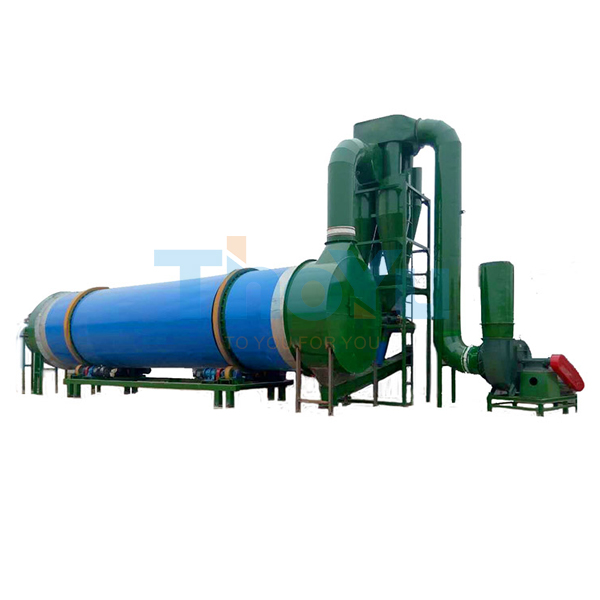
The compact rotary drum dryer uses a horizontally arranged drum with a small inclination angle. As the drum rotates, wood shavings advance continuously under gravity and internal flight action, reducing the risk of bridging and maintaining steady material flow. Unlike indirect systems (where heat must pass through a shell), Tuoyu’s configuration emphasizes direct gas–solid contact, where hot air interacts with the shavings in the drum for faster evaporation.
Continuous conveying without frequent stoppages
The inclined rotating drum supports continuous throughput, which is especially valuable when upstream shredding and downstream pelletizing need stable feeding. In stable operations, continuous dryers typically deliver higher effective utilization than batch systems by minimizing heat-up and cool-down losses.
Uniform drying via controlled turbulence
Direct hot air flow combined with rotating agitation reduces “dead zones.” The target is not maximum temperature, but consistent heat transfer across the material curtain formed by internal flights—key for narrowing moisture spread from inlet to outlet.
Heat-Exchange Enhancement: Internal Flights That Make the Drum “Work Harder”
A rotary drum’s performance is strongly tied to how well it lifts and disperses material. Tuoyu integrates built-in lifting flights (fins) that repeatedly raise and shower the wood shavings through the hot air stream. This increases the effective contact area and boosts convective heat transfer.
Reference engineering impact (typical ranges)
| Parameter |
Conventional drum (baseline) |
Compact drum with optimized flights (reference) |
| Material dispersion in drum |
Moderate curtain formation |
Stronger, more frequent curtain cycles |
| Drying uniformity (moisture spread) |
Wider spread |
Narrower spread with stable airflow |
| Energy consumption (system-level) |
Higher, more sensitive to load swings |
30–50% lower in optimized operation* |
*Energy savings depend on inlet moisture, airflow control, insulation, heat source efficiency, and dust leakage control. Ranges shown are common optimization outcomes reported in biomass drying retrofits and modernized lines.
Temperature Window: 150–180°C for Efficient Yet Controlled Drying
For wood shavings, the goal is to remove free moisture efficiently while avoiding unnecessary thermal stress, excessive dust generation, or resin-related issues in certain blends. Tuoyu highlights an operating window around 150–180°C (hot air temperature), which often balances evaporation speed and material quality in industrial wood residues.
Performance target: ≤10% final moisture content
In many pellet and board applications, a final moisture below 10% is a common benchmark for stable processing and storage. Achieving this reliably requires not only temperature, but also residence time, airflow volume, drum rotation speed, and consistent feed rate.
| Inlet moisture (wet basis) |
Recommended approach |
Operational notes |
| 35–45% |
Standard pass, stable airflow |
Focus on uniform feeding; maintain steady draft to reduce moisture variation. |
| 45–55% |
Increase residence time / reduce feed rate |
Avoid “chasing moisture” by overheating; tune rotation + airflow first. |
| 55–65% |
Pre-dewatering or staged drying |
Consider mechanical pre-drainage; improve cyclone sealing and insulation to protect efficiency. |
Compact Design: Less Footprint, Faster Installation, Lower Civil Work
Space is not a “nice-to-have” in many wood product factories—drying lines are often inserted into existing buildings or squeezed between storage and production zones. A compact configuration reduces the overall installation complexity and can shorten commissioning schedules.
Practical on-site benefits
- Simplified layout planning for factories with limited space.
- Reduced duct length and fewer bends can improve draft stability.
- Lower civil work scope typically means fewer schedule risks.
Why it matters for OEE (Overall Equipment Effectiveness)
Compact systems are often easier to seal, insulate, and maintain. In drying, small leak paths and unstable draft can quietly erode efficiency. Better sealing and more direct ducting typically help maintain a stable thermal profile, especially during seasonal humidity swings.
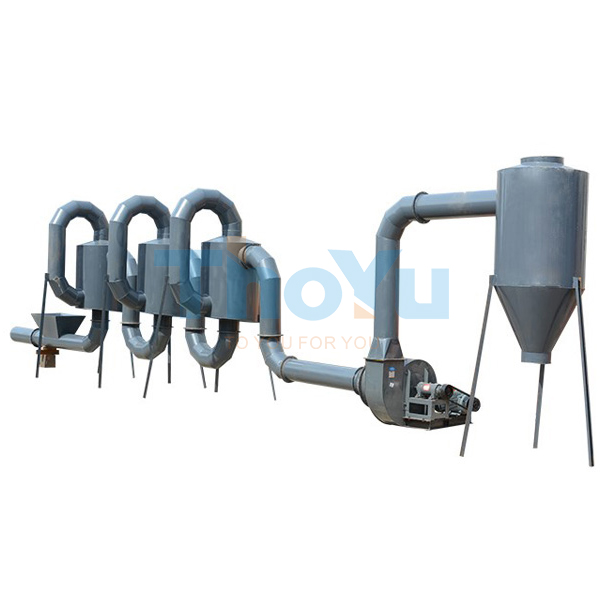
Dust & Emissions Control: Cyclone Separation and Stable Airflow
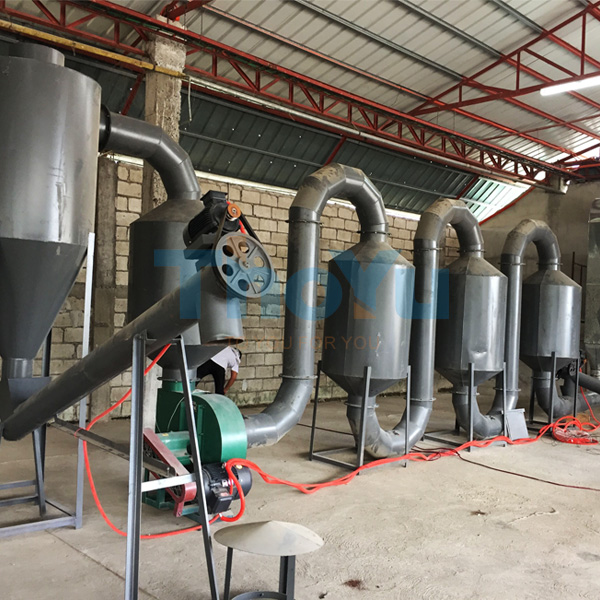
Wood shavings drying inevitably generates entrained particles. A cyclone dust collector is a practical first-stage solution, protecting downstream fans and reducing visible dust in exhaust. In real plants, cyclone performance depends on inlet velocity, particle size distribution, and leakage control; well-tuned systems can reach 80–95% collection efficiency for larger particles (commonly above ~10 µm), serving as a strong base for additional filtration where required.
Optional energy-saving hot air furnace: efficiency is a system decision
Drying efficiency is not only the drum—it is the heat source, insulation, and air management working together. A dedicated hot air furnace option can improve combustion stability and heat utilization, especially when paired with careful draft control and minimized air leakage. In many biomass drying lines, recovering just 5–10% of avoidable heat losses through insulation and sealing upgrades can translate into meaningful annual fuel savings.
A Realistic Application Scenario: From Wet Shavings to Production-Ready Feedstock
Consider a mid-sized wood processing facility handling mixed shavings from planing and sanding lines. Incoming moisture varies after rainy weeks, sometimes climbing from ~40% to ~55% wet basis. Without stable drying, the pellet press experiences frequent fluctuations, and finished pellets show higher fines during bagging.
What changes with a compact rotary drum approach
- The direct hot-air contact and flight design improves moisture uniformity, helping downstream equipment run with fewer parameter resets.
- Operating within the 150–180°C hot-air window supports efficient evaporation while keeping control margins.
- A cyclone stage reduces particulate loading in the system, lowering maintenance pressure on fans and ductwork.
- In optimized conditions, the line targets ≤10% final moisture for stable storage and consistent pellet quality.
What to Ask Before You Specify a Wood Shavings Rotary Drum Dryer
For purchasing teams, the fastest way to reduce project risk is to align technical expectations with the supplier’s sizing logic. Below are the engineering questions that most directly impact results:
Feed material details
Species mix, particle size distribution, bulk density, inlet moisture range, contamination level (sand, bark, resin).
Target and tolerance
Required final moisture, acceptable spread, and whether the line must handle seasonal spikes without throughput loss.
Utilities and compliance
Available fuels, electric capacity, site dust requirements, and whether additional filtration beyond cyclone separation is needed.
Controls & instrumentation
Temperature points, draft/pressure monitoring, moisture sampling method, and alarms for feed interruptions.
Ready to Improve Wood Shavings Drying Efficiency and Cut Energy Waste?
Get the technical details that matter for engineering approval—process flow, recommended temperature window, dust collection configuration, and sizing inputs for your moisture range.
Request the Compact Wood Shavings Rotary Drum Dryer Technical Manual
Typical request items: inlet moisture range, hourly capacity target, heat source preference, site layout constraints, and local dust requirements.